



Early life nutrition sets the foundation for a lamb’s entire lifetime performance. In those first days and weeks, growth is rapid, immunity is still in development, and the metabolic systems are finding their rhythm. Providing the right nutrients in the right form gives lambs the best chance of thriving – and energised lamb milk plays an important role in achieving that.
Industry standards suggest that annual lamb losses on lowland farms in the UK is estimated to be 15%. Losses in hill flocks are thought to be lower, however, the reduction in potential lamb output will detrimentally impact business profitability in any system. Much of this loss is preventable and primarily occurs due to a lack of sufficient quantities of adequate quality colostrum in the first 24 hours post lambing. The first few hours after birth are critical for the survival of the newborn lamb. Ensuring an adequate supply of good quality colostrum is key in supporting lamb health, performance, and survivability.
Colostrum is a nutrient-dense feed that contains a higher fat, protein, and mineral content than ewe’s milk. Not only does colostrum provide essential nutrients to the newborn lamb, but it also stimulates digestive activity and contains immunoglobulins that function as antibodies to support the immune system.
Why Early Nutrition Matters
Lambs are born with a very weak immunity, so it is vital that the first feeding of colostrum is fed within those first two hours of life. Not only is the timing important, but the quality must be high. Using a refractometer, a small drop of the ewe’s milk can be used to measure the Brix %, preferably at 26-27%, reflecting the ewe’s milk’s naturally high fat content. Good early feeding practice will support antibody development and reduce susceptibility to early-life disease challenges.
Colostrum also delivers enzymes, hormones, and growth factors, giving a head start to the metabolic programming. Early-life nutrition influences rumen development, feed efficiency, and overall growth rates long after those first days of life. With expected increases in lamb production after the increase in the 2025 season, reaching that full potential will maximise the profit.
Energised Lamb Milk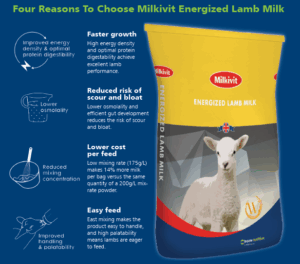
Energised lamb milk replacer has been formulated to more closely match the nutrient density and osmolality of ewe’s milk. Osmolality refers to the concentration of solute particles in a solution – high levels can damage the gut integrity. ELM protects the gut while supplying the energy lambs need.
The high energy density provides critical support for maintaining body temperature, developing immunity, and driving daily growth. Fat sources are highly digestible, using homogenised and dried coconut and palm oil to improves fat digestion and absorption of the diet, as well as easily digestible sources of dairy protein from whey derivatives or skimmed milk. Essential vitamins and minerals are also supplied, with low levels of inorganic sources used, helping lambs’ transition smoothly to their own active immunity, usually around day 6-10.
On-Farm Results
With the 2025/26 lambing season likely to bring weather-related challenges, feeding the highenergy- dense ELM can help lambs reach their full potential. Feedback from farmers has shown evidence of excellent palatability and an increase in growth rates to 0.34kg/day compared to the previous year on another milk powder at 0.23kg/day. This then equates to an extra 3kg of growth for lambs fed on ELM for a month.
By Dr Laura Tennant, Technical Advisor at Trouw Nutrition