



If your reseeding strategy has seen a bit of a wobble in recent years – veering from too much rain to get through the gate, to not enough soil moisture to let seed get out of the ground – then at least you can take heart that you’re not alone, now it’s time to plan a fresh start.
Of course, it’s a fool’s game to guess whether spring 2026 will present favourable weather for reseeding. But more than a few of you will likely have more than a few fields that are not only looking past their best, but probably also performing well below their potential.
Cold, wet, saturated ground will have hampered many swards. Compaction prevents roots from accessing deeper nutrients, and poaching opens bare ground for invasive (and non-productive) weeds. Those same pastures will then have been hammered by high temperatures and long dry periods, burning off and further depressing their yield potential. On top of that, many of the fields thus affected will likely have been those already earmarked for reseeding, among the 15% that’s generally recognised as the ideal annual reseeding or overseeding ‘quota’ to aim for.
Why reseed anyway?
Well, there’s a wealth of evidence to show how reseeded land simply performs better. With the right choice of mixture and varieties, this is your ideal opportunity to ‘modernise’ your pasture. Consider this: Barenbrug’s 30-year grass breeding programme for the UK has provided, on average, a 0.5% per annum increase in grass yield. If it’s been five or seven years since some fields were reseeded, then potentially you’ve got a 3-5% yield increase straight off the bat just from using some of the newest varieties. That’s before you compare the difference between the performance of a tired pasture and one that’s at its peak.
These newer varieties are better at using nitrogen, better at extracting it from the soil. The very quality of these newer grasses is better, too – meaning a more favourable bite for fattening lambs and improved forage overall.
What’s more, when you make that investment in reseeding a pasture, you can increase the resilience of your farm and your business. Don’t focus only on perennial ryegrasses and instead look to the advances that have been made in breeding of other species, such as tall fescues.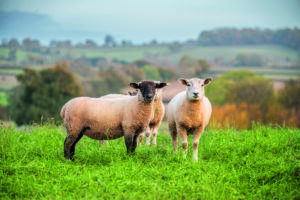
Yes, you may look on fescue as an ‘old’ grass technology. But that’s a myth: new fescues are (almost literally) a breed apart from what you may remember of them. Fussy about pH? Not anymore. Drought resilient? Yes. And alongside those features (as if they weren’t sufficiently attractive) then the quality’s risen in leaps and bounds too.
What system fits?
Hand-in-hand with any decision to reseed should be an evaluation of your current system or production goals. What (if anything) do you need to change? Are you focused on increasing forage quality, smoothing out peaks and troughs of grass production, or finding a route to optimise a limited labour resource?
Another demonstrable point, given both the changing weather patterns we’ve seen in recent years and the likely longevity of your reseeded pasture, is how to build in resilience. A sward sown in 2026 could well see you through into the mid-2030s – but how might weather patterns further change over that period?
Think about mixtures that offer some degree of drought resilience, or forage reassurance in unseasonal conditions: hybrid ryegrasses, for example, offer rapid early-season growth, even at lower temperatures, to offer an early-season bite as well as high yield potential. Meanwhile, your classic diploid ryegrasses will continue to perform slightly better in dry weather.
Diversity
Talking swards, of course – make sure there’s something for every outcome. Not only within each field – the mix of grass species, complemented by grazing herbs such as chicory with its deep roots to break through soil pans and draw up nutrients from lower soil profiles – but across the farm, too. This is particularly important if you find yourself in a position to reseed several fields together. Seek resilience again by choosing different mixtures. Some fields may be well-suited, thanks to their soil, topography and drainage characteristics, to host ryegrass-strong mixtures (rather than a herbal ley, for example).
Take this route, and you might have to accept that while these fields will be handsomely productive under typical rainfall, they’ll perhaps need to be temporarily out of use in dry spells through future Julys and Augusts. But if you’ve got that diversity developing across the farm, then you’ll have an alternative bite to which to turn.
For further information on maximising grassland performance or grassland management, please speak to your local NWF sales specialist or read the NWF Grass & Forage Brochure online.
By Matt Clarke, Barenbrug Account Manager